


























Introduction
1. Introduction to the SDGs
The Sustainable Development Goals (SDGs) were adopted by the United Nations (UN) in 2015 as part of the 2030 Agenda for Sustainable Development.
They consist of 17 goals aimed at addressing global challenges such as poverty, inequality, environmental degradation, peace, and justice.
The SDGs are a continuation of the Millennium Development Goals (MDGs) (2000-2015), but with a broader and more inclusive framework.
2. Purpose of the SDGs
Provide a universal framework for sustainable development that applies to all countries, regardless of economic status.
Aim to create a balanced approach to social, economic, and environmental sustainability.
Encourage global collaboration between governments, businesses, and civil society to achieve common objectives.
3. Understanding the 17 SDGs
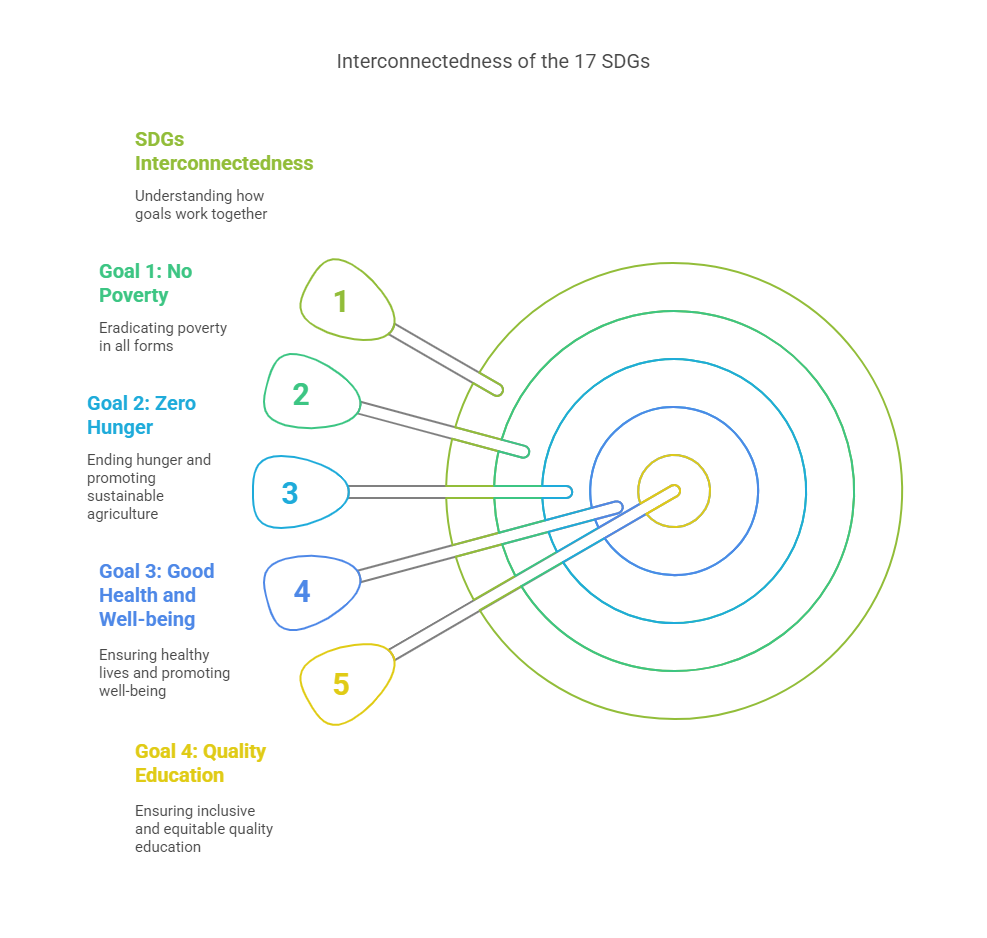
The 17 SDGs are interconnected, meaning progress in one goal often supports others. Below is a brief overview:
| Goal | Focus Area |
|---|---|
| SDG 1 | No Poverty – End poverty in all its forms everywhere. |
| SDG 2 | Zero Hunger – Achieve food security and promote sustainable agriculture. |
| SDG 3 | Good Health & Well-being – Ensure healthy lives and well-being for all. |
| SDG 4 | Quality Education – Provide inclusive and equitable education for all. |
| SDG 5 | Gender Equality – Achieve equality and empower all women and girls. |
| SDG 6 | Clean Water & Sanitation – Ensure access to water and sanitation for all. |
| SDG 7 | Affordable & Clean Energy – Promote access to sustainable energy. |
| SDG 8 | Decent Work & Economic Growth – Promote sustained, inclusive economic growth. |
| SDG 9 | Industry, Innovation & Infrastructure – Build resilient infrastructure. |
| SDG 10 | Reduced Inequalities – Reduce inequality within and among countries. |
| SDG 11 | Sustainable Cities & Communities – Make cities inclusive and sustainable. |
| SDG 12 | Responsible Consumption & Production – Ensure sustainable consumption. |
| SDG 13 | Climate Action – Take urgent action to combat climate change. |
| SDG 14 | Life Below Water – Conserve and sustainably use marine resources. |
| SDG 15 | Life on Land – Protect and restore terrestrial ecosystems. |
| SDG 16 | Peace, Justice & Strong Institutions – Promote peaceful and inclusive societies. |
| SDG 17 | Partnerships for the Goals – Strengthen global partnerships to achieve the SDGs. |
4. Interconnections Between the SDGs
The SDGs do not exist in isolation; they reinforce each other.
Example of interconnections:
SDG 4 (Quality Education) → Leads to better job opportunities (SDG 8: Decent Work & Economic Growth).
SDG 13 (Climate Action) → Protects SDG 14 (Life Below Water) and SDG 15 (Life on Land).
SDG 6 (Clean Water & Sanitation) → Improves SDG 3 (Good Health & Well-being).
5. Challenges in Achieving the SDGs
Financial constraints – Many developing countries lack resources to implement large-scale sustainability programs.
Lack of political will – Some governments do not prioritize sustainability due to short-term economic interests.
Public awareness & engagement – Many individuals and businesses are unaware of how they can contribute.
Global crises – Issues like climate change, pandemics, and armed conflicts slow down progress.
6. Conclusion
The SDGs provide a roadmap for global sustainability, balancing social, economic, and environmental aspects.
Achieving the SDGs requires collective effort from governments, private sectors, and individuals.
Understanding the interconnections between SDGs helps in designing integrated solutions for long-term impact.
📌 Discussion Question:
How can businesses, governments, and individuals work together to achieve the SDGs by 2030?

